Reflective Supervisor Training Program: Understanding Yourself, Guiding Others (OPEN1)
When & Where
Date and Time
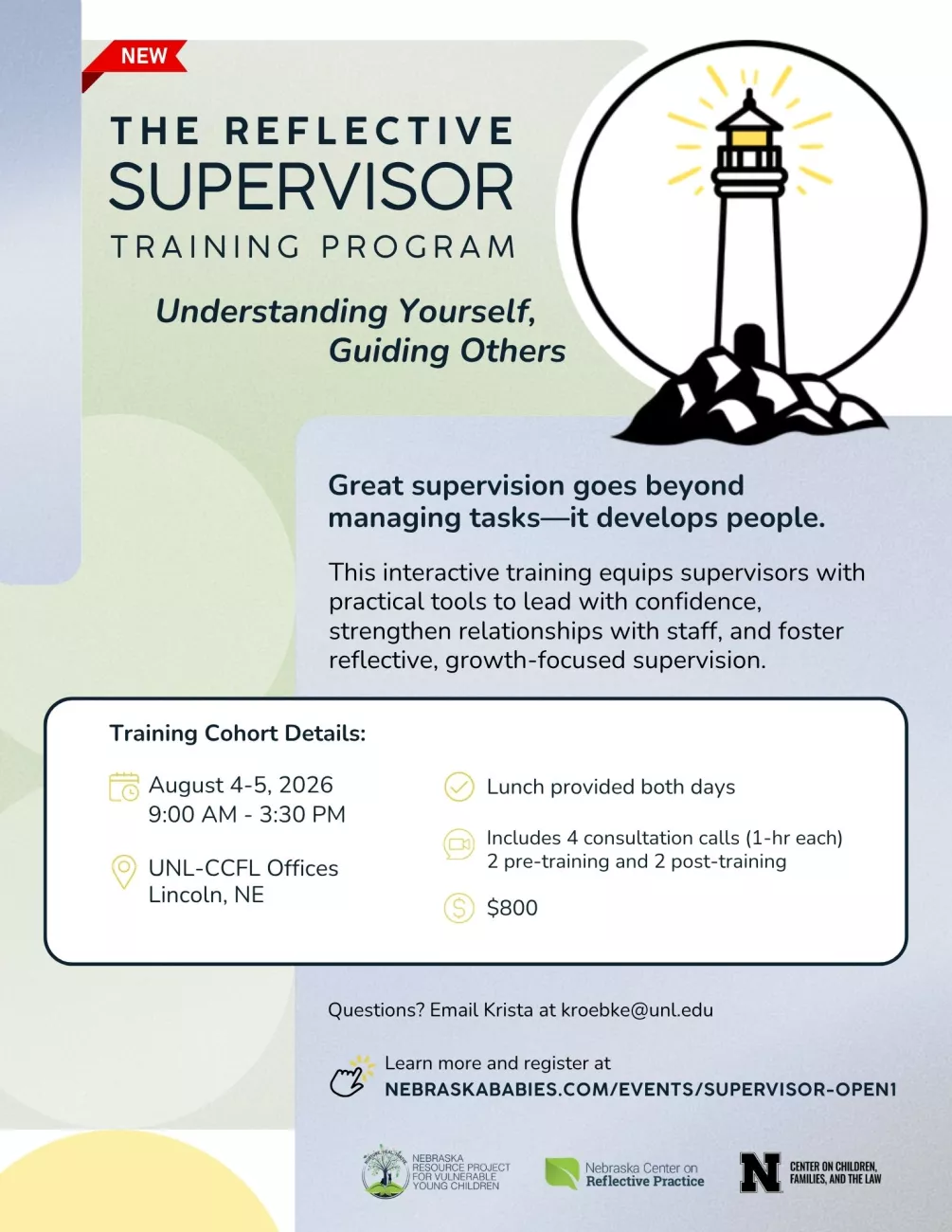
- August 4, 2026 | 9:00am - 3:30pm CDT
- August 5, 2026 | 9:00am - 3:30pm CDT
Location
UNL's Center on Children, Families and the Law; Olson Training Center: 206 S 13th St #1000, Lincoln, NE 68508
About This Training
This training is open to the public.
Great supervisors don’t just manage work; they develop people.
This interactive training helps supervisors strengthen both their internal leadership capacity and their practical supervision skills.
Supervisors will explore the transition into the supervisory role and examine how self-awareness, emotional regulation, and internal narratives influence leadership and decision-making. Through practical tools and guided discussion, supervisors will learn a structured approach to supervision that supports meaningful conversations, builds trust, and strengthens working relationships.
The training also introduces reflective communication and coaching strategies that help supervisors move beyond simply solving problems for staff to develop employees’ confidence, autonomy, and critical thinking. Supervisors will gain practical skills for navigating team dynamics, giving and receiving feedback, and supporting staff through change.
By the end of the training, supervisors will leave with actionable strategies they can immediately apply to strengthen supervision conversations, support employee growth, and lead their teams with greater clarity and confidence.
Training Components
Reflective Supervisor Training:
A two-day in-person training designed to help supervisors strengthen both their internal leadership capacity and their practical supervision skills. The training is structured in two parts—first focusing on the supervisor’s own awareness and regulation, and with those skills, providing effective supervision and staff development.
Reflective Supervisor Consultation Calls:
Participants will engage in a series of small-group consultation sessions before and after the two-day training to support reflection and application of the concepts introduced. Specific dates and times will be scheduled by your consultant.
- Two one-hour pre-training calls will help supervisors begin reflecting on their leadership experiences, explore their strengths and challenges in supervision. Pre-training calls will start 2-3 weeks prior to training.
- Two one-hour post-training calls where supervisors will reflect on how they are applying the skills in their supervision practice. Post-training calls will occur 2-3 weeks following training.
The registration deadline is July 1st.
Lunch will be provided both days of the Reflective Supervisor Training.
All payments are fully refundable up to the day before the first pre-training call. Between the start of pre-training calls and training, NRPVYC will refund 75% of the payment. Once the training begins, payments are not refundable.
Trainer(s)
Tracey Kock is the NCRP Project Manager with the Nebraska Resource Project for Vulnerable Young Children at the University of Nebraska’s Center on Children, Families, and the Law. Tracey is a Reflective Practice Trainer in the Facilitating Attuned Interactions (FAN) model and provides reflective consultation. Prior to her current position, Tracey worked as a Permanency Director in child welfare in Nebraska's Eastern Service Area. Tracey earned a Bachelor of Arts degree in Child Welfare and a Criminal Justice Certificate from the University of Wisconsin Madison and a Master of Social Work degree from the University of Wisconsin Milwaukee.
Krista Roebke is the Program Manager with the Nebraska Center on Reflective Practice with the Nebraska Resource Project for Vulnerable Young Children at the University of Nebraska’s Center on Children, Families, and the Law. Krista manages the Supervisor/Leadership training program. She also provides training support, mentoring, and consultation to the Reflective Practice Training program and provides consultation using the FAN and CE-CERT models.
Prior to her current position, Krista was the Child Welfare Training Manager. In this role, Krista managed training specialists who provided statewide training for the Nebraska Department of Health and Human Services, Division of Children and Family Services. Prior to joining the Center on Children, Families, and the Law, Krista worked in child welfare, beginning in direct care at Boys Town, and then in case management and supervision in both Colorado and Nebraska’s child welfare systems.
Krista earned a Bachelor of Arts degree in Psychology and a Minor in Child Development and Family Relations from the University of Nebraska-Kearney.
Registration Details
RegisterRefund Policy
All payments are fully refundable up to the day before the first pre-training call. Between the start of pre-training calls and training, NRPVYC will refund 75% of the payment. Once the training begins, payments are not refundable.
Questions?
Contact Ashtyn at abeck11@unl.edu